

Setting Boundaries Part I - Individual Contributors
Know Your Limits

A packed calendar. No time for lunch. Dinners at the desk and working weekends.
We joke about these during happy hour, wearing them like a badge of honor or accepting them as the “big tech reality.” But over time, this pace takes a quiet toll. Even the most capable professionals can’t sustain it forever. When they eventually step away, everyone loses: companies lose top talent, and individuals miss the chance to reach their full potential.
In this first part of my series on boundaries, I’m focusing on Individual Contributors (ICs). These are the folks who feel they are constantly falling behind, juggling too much, and wondering where to draw the line and how to protect it.
First things first
For many ICs, overwork does not always come from increasing pressure. It begins with misestimation, communication gaps, and waiting too long to ask for help.
For those just starting out, the transition from school to work is unexpected. In school, teachers set the scope and deadlines. At work, you are often given a task without all the details spelled out and are expected to estimate the effort and set the timeline yourself. That feels empowering, but it also comes with responsibility.

Tim (fictional but realistic), a new SDE1 ready to take on his first project.
His manager says, “Hey Tim, we’ve been getting tickets from customer service about improving error messages in the registration flow. Can you take this up? Take a day to review the details and come back with an estimate.”
Tim spends a day reviewing the code. “Three days,” he estimates. He checks with a teammate. “Seems fine.”
His manager adds a buffer. “Let’s make it five.” It sounds safe.
Now, here is a glimpse of the next five days that led Tim to burn the midnight oil, work through the weekend, and still fall behind.
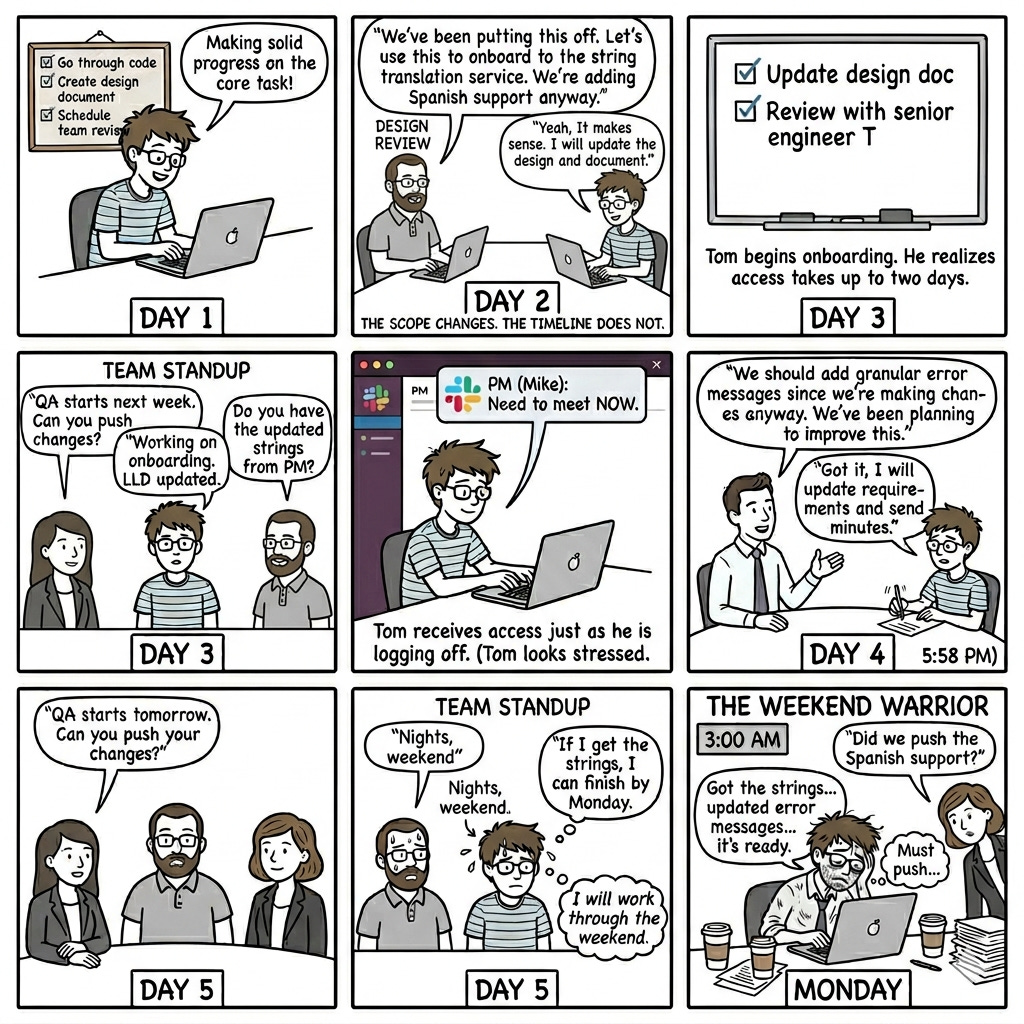
A few patterns show up again and again:
You estimate before fully understanding what “done” actually means.
Scope changes, but you do not speak up about the timeline.
New dependencies appear, but you absorb them instead of calling them out.
You realize you are behind, but hesitate to say it out loud.
For example, in Tim’s case, a few small shifts would have changed the outcome:
When the integration with a new service was suggested, that was the moment to loop in the manager and say, “This new dependency will push me beyond the original estimate. Should we revisit scope or timeline?”
When the PM added more messages, that was another moment to speak up and align on trade-offs: “What moves out if these additional messages are added?”
This is not about pushing back. It is about making the work visible. When you keep your manager and stakeholders informed as realities change, you give them the opportunity to prioritize, adjust scope, or reset timelines.
Your weekend should not become the default buffer for unclear estimates and silent scope creep.
If escalations and requests for help are consistently ignored, and you are still expected to deliver beyond what is feasible, that is a red flag that deserves attention. At that point, it is important to assess whether the issue lies with a specific person or with the environment. For example, in a startup preparing for a critical launch, these conversations are not useful, and the expectation is usually that everyone stretches to reach the goal.
The Cost of being a High Performing Hero
I once had a high-performing senior engineer, Bob (name changed), on my team, and someone I had regular 1:1s with. He was usually very proactive, came well-prepared, and always had some interesting ideas or insights to discuss.
During a 1:1 with him, after about 15 minutes, he brought up: “I wish there were more hours in the day. I feel like I am always having to stretch and work weekends and nights to meet the timelines. Why does leadership not see this problem?”
I tried to understand more from him, and to my surprise, his projects didn’t really have tight timelines.
When I checked with his manager, the picture became clear: Bob was the operations bar-raiser, the SME on multiple services, and generally the go-to person on the team. The manager mentioned casually, “I am not sure why he feels the timeline pressure. I always add buffer to his tasks because he gets pulled into two or three different things.”
Here is a typical day in the office for Bob:
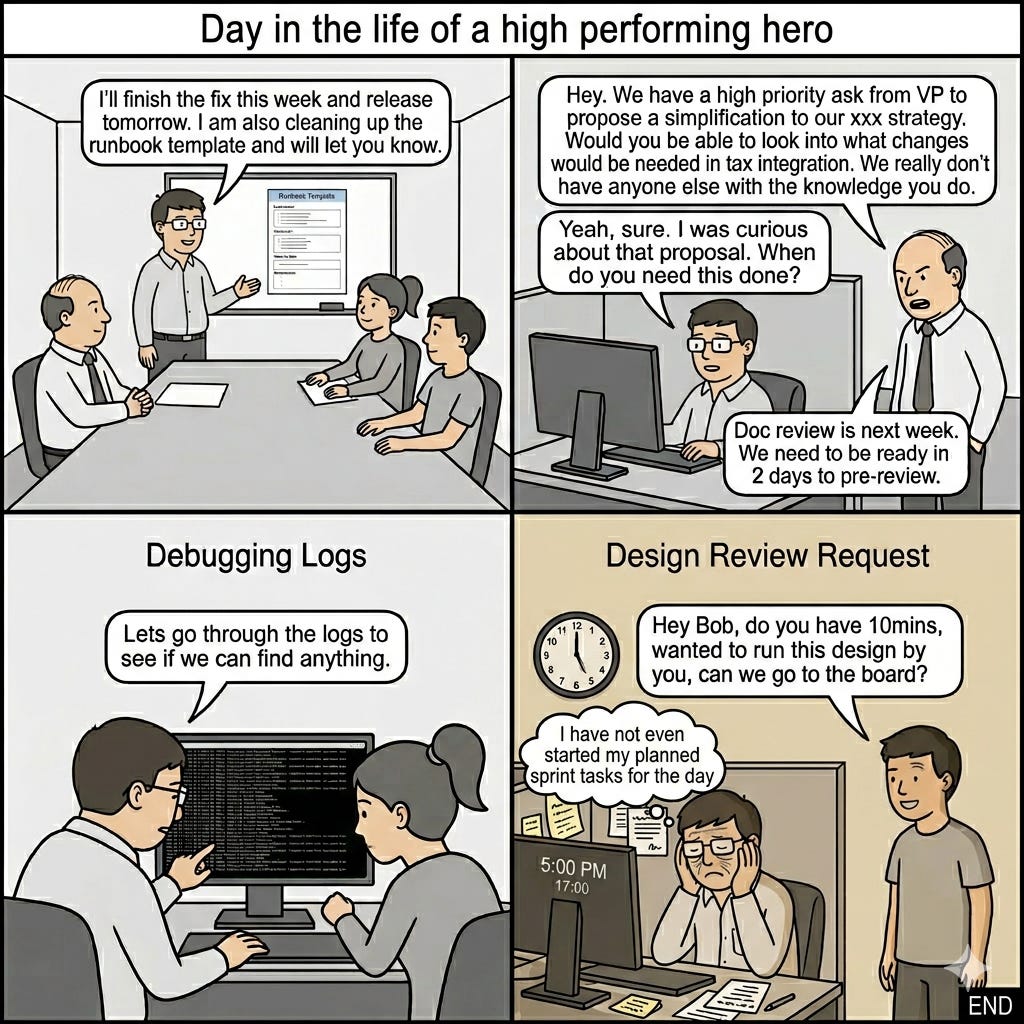
When someone is reliable and always willing to help, they naturally get pulled in multiple directions.
All the threads they juggle stay invisible. Not all work shows up on sprint boards, and the cognitive load of frequent context switching adds up quietly over time.
The reality of most workplaces is that there is always something to fix, improve, or build. If you are not clear about what is expected of you and how your current commitments compare to what else you could take on, it becomes easy to overcommit and gradually drown.
At the same time, you cannot say no to everything outside your planned work. Situations will come up where you are pulled in, such as high-severity incidents, team emergencies, or when you choose to help. Assuming you can handle everything is not a scalable strategy. It may work sometimes, but more often it leads to late nights or giving up your weekends.
In these moments, your responsibility is to make the tradeoffs visible.
How to protect your boundaries and prevent burnout
If you are frequently working late or weekends, use this to identify what is causing it. The goal is to understand where breakdowns happen and make the necessary course corrections before they compound into burnout.
1. Get the basics right
Getting the basics right starts with understanding your capacity. A rookie mistake is assuming 8 hours at work means 8 hours available to plan work. This is not true. You have meetings, design discussions, code reviews, helping a teammate, etc. Early in your career, unplanned time may be around 10 percent of your day, but that grows as you advance. Be clear on how much capacity is already committed before taking on new work.
Once capacity is clear, the rest comes down to discipline with estimation, tracking, and communication so your work stays visible.
Boundaries do not work if they are invisible.
2. The Nice Guy Trap
Do you find yourself saying yes because it is hard to say no? It is natural to want to be helpful, but consistently absorbing unplanned work will eventually show up as late nights and weekends.
A simple way to practice boundaries is to add a small pause. Next time someone asks for help, instead of saying “sure,” try this: “Sure, I can help. If it takes more than 30 minutes, I will need to plan for it and adjust my current commitments.”
Being helpful should not come at the cost of your boundaries or commitments.
3. The SME Trap
Are you the go-to person or sole owner for certain systems or modules? Being a subject matter expert is valuable, but being the only one who knows something creates interruptions and unplanned work. While it may feel like job security, it often leads to constant context switching and unpredictable workload.
The way out is to prioritize sharing your knowledge: document well, share, and enable others to participate so ownership is distributed and you are not a single point of dependency.
Subject matter expertise should be a superpower, not a time sink.
4. The Curiosity Trap
Are you someone who enjoys exploring, learning, and self-directed work? If you do, be intentional about how much time you allocate to it each week. Plan for it so that curiosity does not quietly spill into time needed for committed work.
Your curiosity should complement your commitments, not compete with them.
5. Handling trade-offs
When new work comes in, do you explicitly ask: “What should move down or out if this comes in?”
Many ICs avoid these conversations because they see escalation as complaining or worry about political implications. In reality, escalation helps rebalance priorities, resolve conflicts between stakeholders, and prevent invisible overload.
If you are not having this conversation, you are implicitly accepting more than your capacity.
Boundaries are not just about saying no. They are about making trade-offs explicit, and that is a core part of the job.
Now Your Turm
You do not need to fix everything at once. Start by identifying one or two areas where you consistently slip, whether it is estimation, communication, or overcommitment, and make adjustments.
Starting today, track where you spend your time for a week to identify which areas need more visibility, which are time sinks that need to be stopped, and which need to be dialed back.
If, after doing everything within your control, you are still frequently asked to stretch beyond your limits, take a closer look. Is this a person-specific issue or something systemic in the environment? Let that answer guide your next step, whether it is adapting for a temporary need, changing teams or managers, or considering a job change. The key is to make the decision with full awareness.
If this resonated, leave a ♡ so I know what topics are helpful.
I would also love to hear what makes it hard for you to set and protect boundaries. Write to me or comment below.
Very insightful article for both new joiners and experienced people. Setting right priorities for other events is equally important. I
Another great article Vasantha! Thanks for sharing. I think a lot of Amazonians (like myself) deal with the imposter syndrome that contributes to burning the midnight oil! That desire to perfect everything slowly eats away at time, and its a hard thing to change for anyone - whether you are early in your career and eager to prove yourself or you are a tenured senior carrying the weight of experience and wanting to ensure the work reflects the standards you’ve helped establish.
I believe Gen-AI can also be a powerful tool in addressing some of these challenges. It democratizes knowledge, helps with log deep dives, and can suggest new avenues for exploration. That said, it remains to be seen what new problems it might introduce.