

Rapid Growth
Is it always a boon?

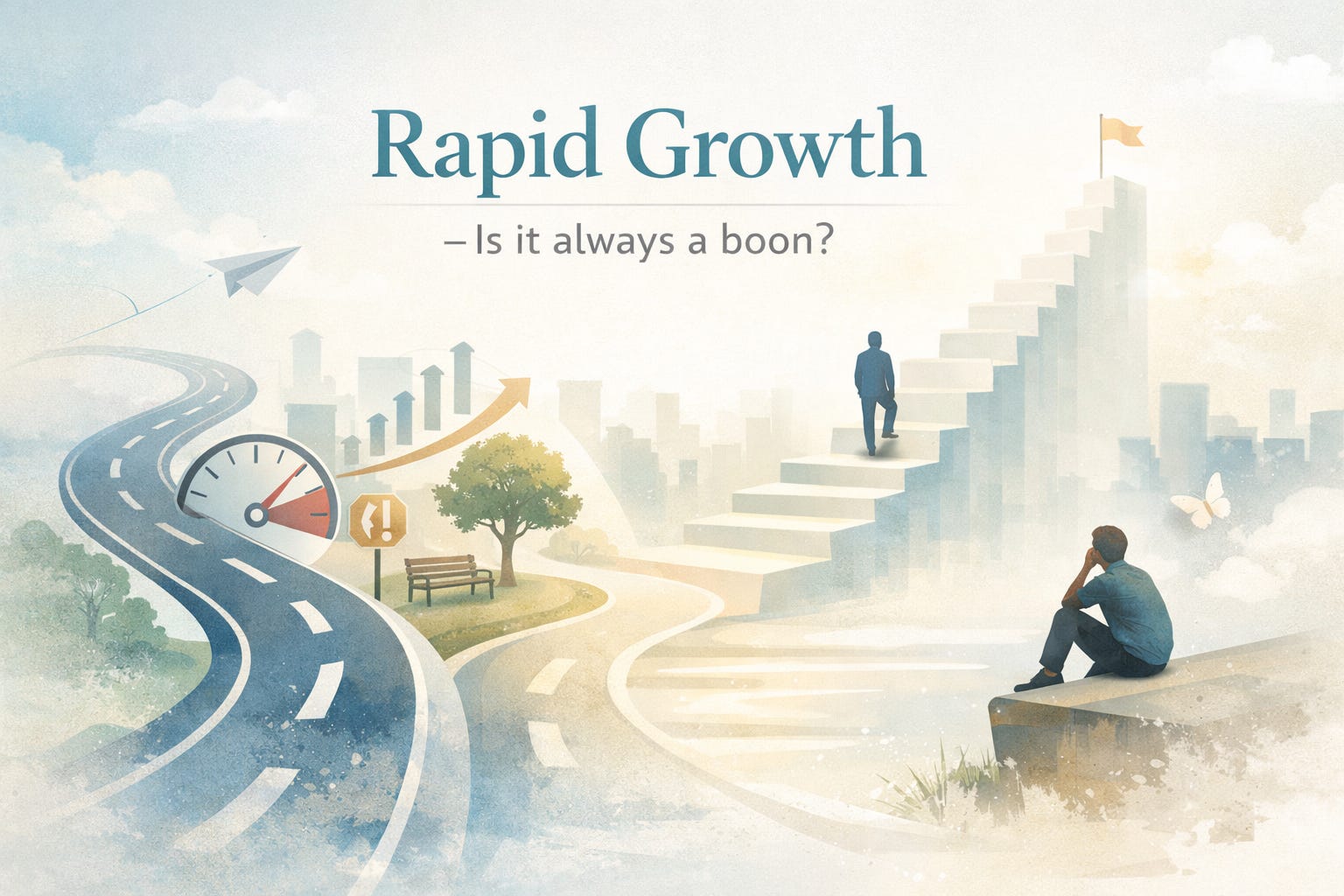
Imagine you are driving somewhere that Google Maps says is 7.2 hours away. Are you the kind of person who looks for shortcuts and pushes the speed limit to arrive in 6 hours? Or someone who is happy to reach in 8 hours with a relaxed stop along the way? Or someone who simply follows the directions without thinking much about the time?
Many people approach their careers like the first driver. Every move optimized for speed, leaving little room to experiment or explore new roles.
I find it more helpful to think of a career as a journey where the destination can shift as you learn more and discover new possibilities along the way.
The Shift
Years ago, promotions were largely driven by tenure. There were still outliers who advanced quickly because of exceptional talent, but they were rare.
The tech boom changed that. Over the past decade, especially with fast-growing companies like FAANG, rapid promotions became more common and expectations shifted. The bar also became uneven, sometimes even within the same company. Job titles are also not consistent across companies. A Senior Engineer in one company may operate at the scope of a Principal in another, while the same title elsewhere may have far less responsibility. In reality, titles travel easily across companies. Skills do not.
Many are constantly comparing themselves to others and feeling as if they are in a race to keep up. That kind of comparison creates constant anxiety and can be exhausting.
Purely tenure-driven growth is one extreme. Constantly chasing promotions is the other. The healthier path lies somewhere in the middle, balancing merit, experience and opportunity.
Sustainable careers are built by balancing opportunity with deliberate skill building.
In this post, I will share a more sustainable way to think about growth. One that helps you stay motivated, validated, and marketable without the stress of constantly trying to outrun everyone around you.
Balancing Growth with Learning
At any stage of your career, your primary focus is to perform and out-perform at your current role. Seek regular feedback from your manager and peers so you have a clear sense of where you stand. Here is my earlier post on Performance:

Do not assume promotions happen automatically. They rarely do. Even the best managers tend to invest more energy in those who take ownership of their careers and are open about their aspirations.
Promotion timelines are usually guidelines rather than strict rules. Some people move faster than expected. If you believe you are ready sooner, discuss it openly and ask for an honest assessment of the gaps you may still need to close.
Rapid growth can sometimes happen almost accidentally. If your team or company is expanding quickly, you may rise along with it. Managers may see it as less risky to promote someone they know rather than hire externally.
For example, when I joined Sapient out of school, the company had about 70 employees. I was growing rapidly to leadership roles because the company needed me to. At the time I did not fully grasp what was happening. I was simply focused on delivering for the team. The work was fast paced and the learning constant.
Within a couple years I was spending most of my time managing teams and dealing with clients, and less time writing code. That was risky for someone who wanted to grow as a technical leader. Moving away from your core skill too early can weaken your foundation. For someone pursuing a business or client-facing path, however, the same opportunity might accelerate their career.
Not all opportunities are equal. Some limit you, while others enable you.
So I made a deliberate choice to step back into an individual contributor role for a period of time, get hands-on again, and deepen my technical foundation before continuing on the managerial path.
I saw a similar dynamic at Amazon during periods of rapid hiring and growth. Promotions were happening much more quickly in some organizations, sometimes before candidates had fully grown into the expected scope.
Rapid promotions often happen during moments like these:
Hyper growth companies
New organizations being built
Leadership gaps
New products launching
Sometimes promotions reflect company growth more than individual readiness.
Recently I mentored an Sr. Engineer(L6) who was not sure why he was not getting hired internally or clearing interviews elsewhere as a Senior SDE. After reviewing his work, the gap was clear. He had been promoted too quickly and had not yet built the skills expected at that level. This is the risk of growing too fast on paper without deliberately building the skills to back the title.
A useful question to ask yourself from time to time is simple. If I were interviewing outside today, would I clear the bar for the level I currently hold?
If the answer is uncertain, it may be a signal to pause, understand the bar and deepen your skills.
At first, rapid growth feels exciting and validating. But it can also carry hidden risks. When someone is promoted before fully absorbing the previous level, they often end up learning two jobs at the same time. Some navigate this well. For many others it quietly creates pressure, impostor syndrome, and a feeling of always being slightly behind what the role demands.
Growth is Multi-dimensional
Once you reach what many organizations consider a terminal level, continuing to grow upward becomes a choice. At mid-career levels, growth is no longer just about skills and delivery. It increasingly becomes about depth, domain expertise, leadership, and influence. At this stage there is no single path forward.
Because of this, progression needs to be intentional. If you want to grow to the next level or try an alternate path, it helps to take on elements of the role before formally stepping into it and then work with your manager on a clear growth plan. Here is my previous article on being intentional about growth:

What got you here will not get you to the next level. At this point, you usually will need to choose: deepen your craft and continue on the IC path, or shift toward management. A Senior Engineer may be deciding between becoming a Principal or moving toward a Manager role.
Moving from L6 to L7 (Manager to Sr. Manager or Senior Engineer to Principal) is not simply about demonstrating more technical or managerial skill. It is largely about influence and impact.
This is where many L6s struggle.
At this stage scope is rarely handed to you. You are expected to create it. That means thinking bigger, influencing leaders, securing investment, and delivering meaningful results. Building these skills takes time and effort.
If your organization is not investing in the area you work in, demonstrating next level impact becomes much harder. Understanding the rules of the game is important. Alignment with your manager regarding opportunity and potential matters.
Sometimes you may find yourself on the favorable side of a reorganization and suddenly inherit additional scope. If you are ready, this can be an accelerator for your growth. But I have also seen the opposite. ICs who were stretched into management or managers pushed to Sr. manager before they were ready can struggle to scale. Being in the wrong role or getting promoted prematurely at these levels tend to have longer term consequences. Reputation risks at this stage take much longer to recover from.
Lasting Impact and Influence
At senior leadership levels (Director+), promotions naturally become less frequent. Growth at this stage is less about scope alone and more about experience and influence, both of which take time to build.
This is a good moment to pause and ask yourself what you truly enjoy doing day to day and where you want to spend your time and energy. Once you answer that honestly, you will know whether you even want the next promotion. For example, your day will look very different as a tech director vs a GM.
There is plenty of advice on how to climb the ladder, but far less on how to be intentional about growth. Even less is written about how to think ahead and plan for lasting impact and influence in the later stages of a career. The reality is that none of us will hold intense senior roles forever. Over time, both body and mind begin to nudge us to slow down.
It is helpful to think ahead about how you want that phase of your career to look. How would you like to stay engaged and continue influencing the next generation of leaders even when you are no longer interested in the day to day execution.
Thinking about this early helps you shape the kind of lasting impact you want to have.
Now Your Turn
Social media often creates the illusion that everyone else is moving faster than you. Your feed is full of posts like “Promoted to Director in five years” or “Staff Engineer at 27.” It is easy to start wondering if you are growing fast enough. Many professionals I speak with worry about whether their careers are progressing fast enough. At the same time, they carry the fear of falling behind in their current role.
From time to time, it helps to step back and evaluate your growth more objectively. Ask yourself:
Do I deeply understand the skills expected at my current level?
Could I get hired at this level at another company?
Am I mentoring people successfully at the level below?
Am I solving bigger problems and developing deeper expertise, or simply managing more people?
Sustainable career growth rarely comes from moving as fast as possible. It comes from building depth first and expanding your scope deliberately. Early in your career, investing in your craft compounds over time. Later, influence and impact begin to matter more than titles.
Promotions will come and go depending on company cycles and leadership changes. The people whose careers endure tend to focus less on the speed of the journey and more on steadily increasing the value they bring to every role.
The goal is not simply to grow fast. The goal is to grow in a way that lasts.
Well said. I particularly like your point about being intentional about growth. It takes conscious effort to examine different possible sequences of “next” paths and discern which might be more fulfilling for your future self. I also truly believe that we craft our own lives and can iterate and adapt - we can learn from a given choice and make modifications based on that experience.